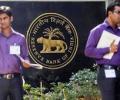
Richard Illey, chief economist, (Asia, ex-Japan) at BNP Paribas, talks to Business Standard on inflation and related issues ahead of the Reserve Bank's annual review of monetary policy.

The common man's main grouse is high inflation numbers. But there are other anomalies as well that need to be addressed.

Costlier fuels, including LPG, pushed up inflation to 5.38 per cent for the week ended December 6 -- the fourth week in a row that saw rising inflation -- even as prices of vegetables, rice and some edible oils declined.
The move aimed at blunting Finance Ministry, RBI's opposition to monthly reporting.

Ahead of the monetary policy review on May 3, Reserve Bank of India (RBI) Deputy Governor Shyamala Gopinath said inflation was a concern, mainly on account of the high prices of non-food manufacturing goods.
The inflation rate fell marginally to 4.88 per cent during the week ended November 8 despite a rise in prices of essential items like wheat, tea, maize, textiles, paper, metal and machines.

Inflation measured by the Wholesale Price Index had declined to 6.62 per cent in January. It was 7.18 per cent in December and 7.24 per cent in November.
In an earlier analysis for the period till April 26, it had been found that of the 365 items in the WPI, the index for as many as 166 items had not been revised for more than four months. The latest analysis as of June 21 shows that the index for around 55 of these 166 items has been revised. In effect, only one-third of the items have seen an index revision. During this period, headline inflation has moved from 8.27 per cent to 11.63 per cent.
The wholesale price index stood at 6.21 per cent during the corresponding week a year ago. Prices of maize, arhar and moong declined by one per cent each. However, prices of fuel remained unchanged at the previous week's level.

However, risks to the outlook stems from possible sub-normal monsoon and higher crude oil prices (on account of the crisis in Iraq)," the Economic Survey 2013-14 tabled in Parliament by Finance Minister Arun Jaitley said.
Interestingly, it is the long products that have witnessed the steepest price increase (between 50 per cent and 62 per cent), clearly reflecting the booming demand from construction activities. However, the flat products, by comparison, have seen a price increase of 17-24 per cent, almost half compared with the long products. Driven by demand, the share of the long products in the total steel production has been steadily increasing.

As per commerce and industry ministry data, food inflation fell to 4.91 per cent in March from 7.79 per cent in the previous month.
Inflation has risen to -1.21 per cent for the week ended July 4 against -1.55 per cent the previous week.
In the previous week inflation was (-) 1.54 per cent. Wholesale price index-based inflation was 12.53 per cent during the corresponding week a year ago.
Food inflation fell sharply to a near four-year low of 1.81 per cent for the week ended December 10 as prices of essential items like vegetables, onion, potato and wheat declined.

The rate of price rise in food items stood at 17.14 per cent in the corresponding week of 2010.
Inflation declines to 3.65 per cent for the week ended December 8, compared to 3.75 per cent in the previous week, mainly due to fall in prices of food articles and some manufactured items. The wholesale price index-based inflation stood at 5.63 per cent in the corresponding week a year ago.
According to data released by the government on Thursday, onions became cheaper by 39.20 per cent year-on-year during the week under review, while potato prices were down by 15.75 per cent.
Eggs, meat and fish also became 13.36 per cent more expensive on an annual basis, while cereal prices were up 4.13 per cent.
As per data released by government on Thursday, price of pulses became cheaper by 5.63 per cent year-on-year.

Food inflation, as measured by Wholesale Price Index, stood at 9.13 per cent in the previous week.

Meanwhile, inflation of non-food articles was at 15.50 per cent for the week ended July 9, compared to 15.20 per cent in the previous week.
The wholesale price index, coming below four per cent, may prompt the Reserve Bank of India to cut key policy rates. An indication was made by the RBI Governor D Subbarao in Tokyo on Wednesday. During the week, prices of manufactured items such as sugar, imported edible oil and textile items such as cotton yarn got cheaper.

As per the official data released on Monday, inflation in food items was 9.94 per cent in March, as against 6.07 per cent in February.

Benchmark 10-year bond yields hit a 13-month peak as bond traders priced in more aggressive monetary easing next year.
Reversing its upward trend, inflation fell to a two-year low of 4.07 per cent in the week ended July 23 due to cheaper food products even as prices shot up for minerals, including iron ore
Inflation fell to a 31-week low of 5.6 per cent for the week ended January 8 despite a hike in prices of fuel, vegetables, non-food and manufactured products.
On an annual basis, prices of food articles went up by 8.19 per cent in July, which is lower than the 8.38 per cent inflation recorded in June.
Inflation based on the wholesale-price-index remained unchanged at 6.46 per cent for the week ended March 17 when compared to the week before. In fact, inflation is now unchanged for the last three weeks.

The rate of price rise in food items, as calculated on the basis of the wholesale price index, was 8.53 per cent in the previous week and 21.46 per cent in the comparable period of 2010.
Headline inflation rose to 9.44 per cent in June on the back of rising prices of fuel and manufactured products, which may prompt the Reserve Bank to raise key rates again in its quarterly policy review later this month.
Inflation rose to 5.91 per cent during the week ended April 23 as vegetables, fruits, edible oil, industrial fuel and manufactured products became costlier.
As per data released by the government on Thursday, pulses became over 9 per cent cheaper year-on-year during the period under review.
The latest numbers are the highest level of food inflation since the week ended March 26 when it had stood at 9.18 per cent.
This lack of regular and detailed disclosure by companies or respondents lies at the core of the problem, one that has gained ground in recent weeks.

This is the lowest rate of price rise in food items in the last 18 months, when separate data for food inflation first started coming in.

Inflation based on the Wholesale Price Index (WPI) stood at 6.84 per cent in February. In March, 2012, it was 7.69 per cent.

Wholesale Price Index for the month ended March moderated to 3-year low of 5.96 per cent against Reserve Bank's projection of 6.8 per cent.
Inflation fell for the second consecutive week to 7.02 per cent for the week ended December 4, mainly due to cheaper primary and fuel products.
